A woman told Chicago police she feared she was drugged before being sexually assaulted at a University of Chicago fraternity house earlier this year, according to a police report.
On Feb. 8, a day after the assault reportedly happened, the 19-year-old told officers the alleged assailant gave her a shot of alcohol that “might have been laced,” the report says.
“The grief that this has imposed upon me is indescribable,” the woman told NBC News. “It is the first thing I think about whenever I wake up every day and the last thing I think about whenever I fall asleep.”
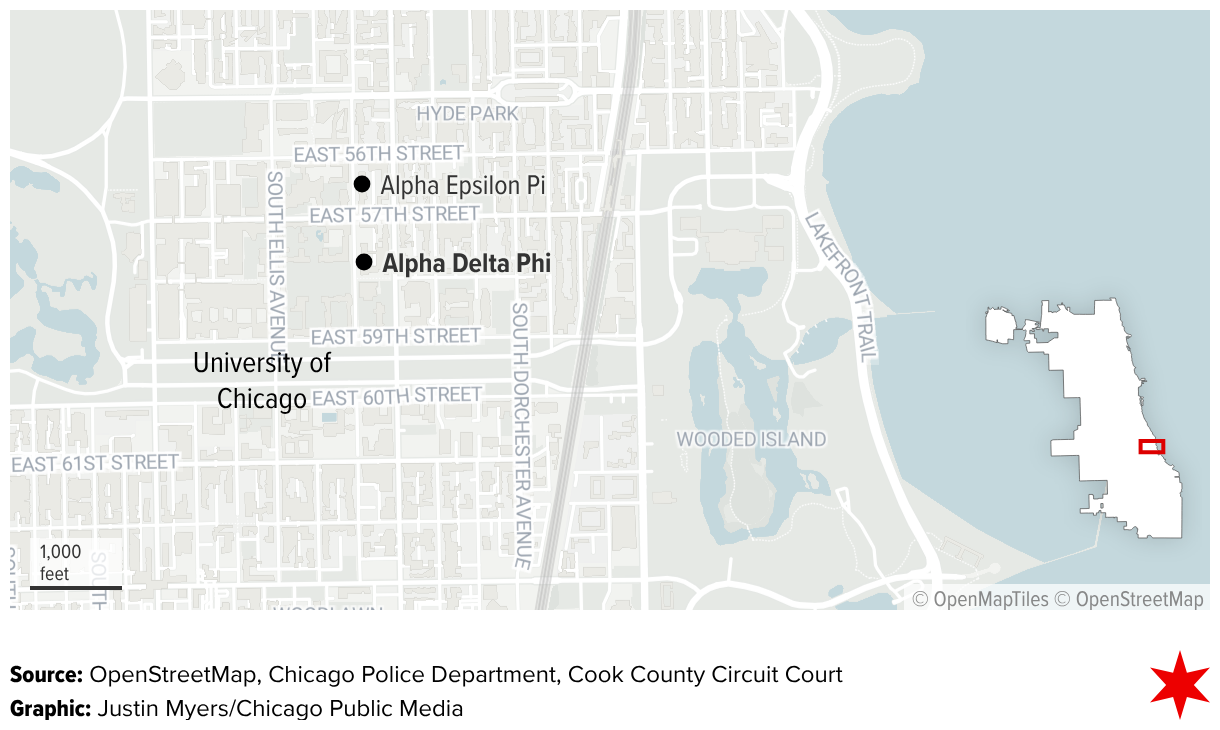
The woman filed a lawsuit Monday against the local and national Alpha Delta Phi organizations, alleging a member of the fraternity had assaulted “her limp body” during a party at the Alpha Delta Phi house, 5747 S. University Ave. The woman was identified only as “Jane Doe.”
The lawsuit came soon after another woman reported she was sexually assaulted on Oct. 11 at an off-campus party at the Alpha Epsilon Pi house, located just a block away at 5625 S. University Ave. Witnesses in that case reported the accuser appeared “significantly more intoxicated than expected based on her reported alcohol consumption," according to another police report.
The two cases have placed the University of Chicago at the center of a national reckoning over sexual violence at colleges, sparked by reports of gang rape and drugging at a fraternity house at Cornell University in upstate New York.
The school's Public Safety Advisory Council, comprised of students, faculty, staff, and community members, discussed sexual misconduct on campus at a Wednesday night meeting. The council couldn't answer questions about the specific reported sexual assaults, but said it could make an official recommendation to the administration on how to address sexual assault on and near campus.
"This is literally the first time we've touched on this topic," said Sharon Fairley, a professor at the university's law school and chair of the council. "This is a learning process for us ... we're in the very early stages right now to see if this is a topic that is of such interest to the community where we feel like there may be a policy gap and we do want to make a recommendation, so we haven't gotten there yet."
The University of Chicago previously alerted students to a spate of alleged druggings in November 2022, warning of seven reports of undergraduates who suspected their drinks had been spiked at parties.
In one case, a student reported they were “likely sexually assaulted.” The university said at the time that “such behavior is unacceptable, not tolerated within this community, and may be criminal.”
Elizabeth Spratt, former toxicology director for Westchester County in New York, said “timing is everything” when it comes to testing for potential drugs, noting levels could be low by the following morning. "These [cases] break my heart, because they're ... hard to prove because of timing," Spratt said.
The women alleging they were assaulted at the two fraternity houses aren’t students at the University of Chicago.
The woman identified in her lawsuit as Jane Doe said she had two shots of alcohol at the Alpha Delta Phi house before meeting the alleged assailant, according to the police report. The suspect, identified in the lawsuit and the report as Kevin Shim, then gave Jane Doe another shot, after which she told police she “vaguely remembers anything,” the report says.
“I know myself, and that was not the amount with how intoxicated I felt after the shot that I took with him,” the woman told NBC News. “I’ve never felt like that before.”
In the lawsuit, she said she felt “unsteady and lightheaded” almost immediately after taking the drink. She was then brought to an upstairs bedroom where the fraternity member assaulted her and left her “alone and unconscious,” according to the lawsuit.
“I remember backing onto the bed because I knew what was about to happen, but I just — I didn’t feel like I was strong enough to get out,” she told NBC.
Other fraternity members blocked her friends from getting to the bedroom as the assault was happening, the lawsuit says.
Jane Doe went to Chicago police the next morning and was treated at Illinois Masonic Hospital, according to the lawsuit and the report.
The lawsuit doesn’t mention she was potentially drugged, but her lawyer continued to raise that allegation in an interview.
“This situation is someone that really took all the right steps,” Georgia Booth, one of Jane Doe’s attorneys, said in an interview. “The next morning, she went to the hospital, got a toxicology report and a rape kit done, and then immediately spoke to the Chicago Police Department.”
Alcohol-involved sexual assault is incredibly common on college campuses, according to Erin O'Callaghan, an assistant professor at Colorado State University. In some cases, it is combined with drug use, either voluntarily or involuntarily, said O'Callaghan, who researches substance-involved sexual violence.
While voluntary substance use is still more common, there is limited national research on drink "spiking," particularly as the types of drugs used continue to evolve, according to O'Callaghan.
“Survivors, depending on what type of drug combinations, may be disoriented,” O'Callaghan said. “Even trying to piece together what happened to me is not necessarily instantaneous for people, particularly when we know that sexual violence is less likely to be acknowledged by survivors when substance use is involved."
But months later, the police investigation is still pending. Booth said she’s requested additional information but has only been provided the original incident report — and not the findings of the toxicology or sexual assault testing.
Booth said she had “no idea” why there still weren’t any charges in the case.
“Unfortunately, I work with survivors of sexual assaults primarily in my practice,” Booth said. “I work with clients that have made similar reports to the Chicago Police Department. Sometimes they get little to no investigation done into their experience. So we're encouraging the police department to continue investigating, and hopefully charges will be brought soon.”
The university, the police department and the national Alpha Delta Phi organization didn’t respond to questions Wednesday.
The university previously said the allegations in the lawsuit were “disturbing.”
“The University of Chicago is committed to addressing and preventing incidents of sexual assault,” the spokesperson said in a statement Tuesday. “The University is not a defendant in the lawsuit against the fraternity. The University will cooperate by providing information and is prepared to help the Chicago Police Department in its investigation.”
At Wednesday's meeting, which drew a packed crowd inside the Drexel Building, Belinda Cortez Vasquez, associate dean of students for Student Affairs, listed university resources, including the University of Chicago Sexual Assault Dean-on-Call Program and the school's Center of Awareness, Resolution, Education and Support.
Students and staff are required to complete a training program on sexual misconduct, which Fairley said is "very, very comprehensive," but the council couldn't answer a question about following up on the training and tracking its effectiveness.
Kyle Bowman, chief of the University of Chicago Police Department, acknowledged that the climate surrounding sexual assault at the university has become increasingly tense in the wake of the two reports.
"I'm just gonna be blunt, the first thing we need to do is tell men not to commit sexual assault, to respect the people that they're with," Bowman said.
When asked if members of fraternities or sororities should be subject to specific training, Bowman didn't directly answer, but said the police department starts each quarter with safety presentations in residence halls and social spaces on campus.
Alpha Delta Phi said "the member involved" was suspended from the fraternity after the organization became aware of the reported assault, which it takes “extremely seriously.” Shim hasn't responded to a request for comment.