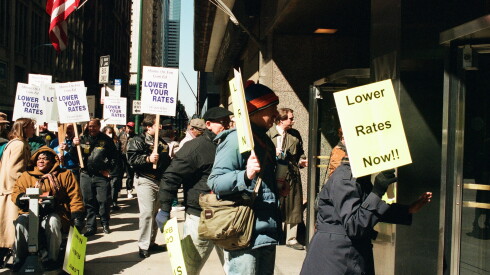
On the afternoon of Aug. 12, 1999, a blackout roiled Loop businesses, knocking out power at the Chicago Board of Trade before markets closed, darkening office buildings and trapping people in elevators. Traffic lights were out as cops tried to direct traffic. It was chaos.
No one expected this blackout, which lasted 11 hours in some spots.
Mayor Richard M. Daley was furious at the electric company, ComEd.
“This company has to go down to ground zero and start all over again, get rid of all your engineers, bring contractors in, bring outside engineers. This is an emergency,” Daley fumed.
ComEd admitted the mayor was right, and the utility went to work to improve the decades-old grid.
No more blackouts.
More than 20 years later, the electric grid is stressed again.
It’s being tested by demand from huge data centers rapidly multiplying to power artificial intelligence.
According to some estimates, the number of data centers has doubled in the last few years. Around 5,000 data centers are operating, under construction or proposed across the country, according to industry estimates. That includes more than 100 in northern Illinois, and almost everyone needs enough electricity to power a midsize city.
Data centers require every bit of electricity that Illinois power sources — nuclear, coal, natural gas, wind and solar — can produce.
ComEd customers are seeing higher bills, in large part because data centers are expanding everywhere. Even as ComEd continues to spend money on improving the electric grid, the high demand for power is setting up a potential crisis.
Let’s take a step back to understand how all this works.
The electric grid is really just the poles, transmission lines and other equipment that helps move electricity to our homes and businesses from power plants.
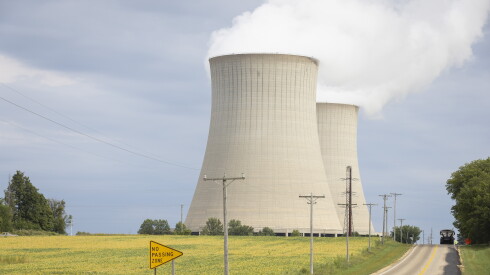
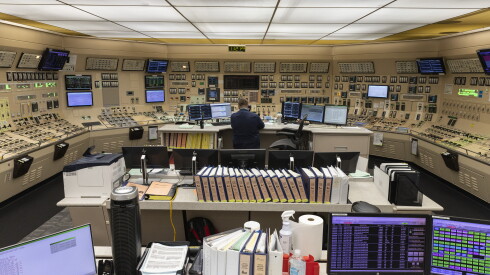
For instance, nuclear power is created at one of six plants in Illinois. It’s sent through power lines, stopping at different substations along the way that control the amount of power that gets delivered to your house.
More than half the energy used in Illinois comes from nuclear sources.
When power is created by a plant or by a wind or solar farm, it’s delivered through equipment owned by ComEd in northern Illinois.
The generation and delivery of electricity are two separate operations and have been for decades.
Chicago and the northern Illinois grid is connected to a dozen other states across the eastern United States, as well as Washington, D.C. The arrangement, in place since 2004, allows states to give or take power from partners in what’s known as the PJM Interconnection grid. PJM buys power for supply across the multistate consortium.
Top of mind for PJM is making sure there is plenty of power even when demand is sky-high — like on the hottest day of summer when everyone is cranking air conditioners.
However, because these data centers require enormous amounts of energy, the price of electricity is determined by the needs of this larger pool of states. ComEd customers began seeing their bills go up in 2025.
Just six years ago, nuclear plants in Illinois were in danger of closing because power demand wasn’t growing.
That’s all in the past.
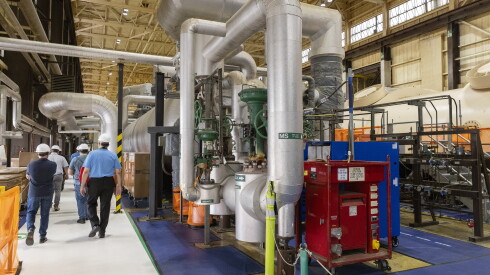
Inside the Byron Nuclear Power Plant near Rockford recently was even noisier than normal, with huge pieces of equipment being moved in for a large-scale maintenance operation.
The plant is scaling up with $355 million in improvements so it can produce even more power.
Newer, more efficient equipment “will provide a higher output,” plant manager Shane Harvey says.
These improvements are necessary to keep up with the demand for power.
In Illinois, nuclear plants were hailed early on as highly reliable, producing massive amounts of energy. In recent years, environmentalists have embraced nuclear power as a cleaner source than coal and natural gas, which contribute to climate change.
Today, AI data centers drive up demand for power and the electricity prices that we’re paying.
It’s a situation so out of hand that President Donald Trump has asked Big Tech executives to pledge to foot the bill.
Closer to home, Gov. JB Pritzker has stopped giving data center developers financial incentives to build massive power-hungry hubs until Illinois lawmakers pass laws to address soaring electric bills.
In addition to high power bills for consumers, the data centers threaten one of the governor’s signature accomplishments on climate change.
In 2021, Pritzker signed into law a measure that eliminates harmful carbon dioxide from power plants by the middle of the century. Carbon, released by coal and natural gas plants, is a greenhouse gas that contributes to global warming.
These fossil fuels will continue to burn, heating up the planet and contributing to respiratory problems in people, until the production of cleaner forms of energy are up and running.
Related to Trump’s ask of Big Tech, Google is investing in five nuclear power plants in Illinois to make sure that the energy continues to flow. It may not be enough: Politicians are talking about mandatory rules that hold the data center developers and owners more accountable.
Until then, consumers are left footing the bill.