
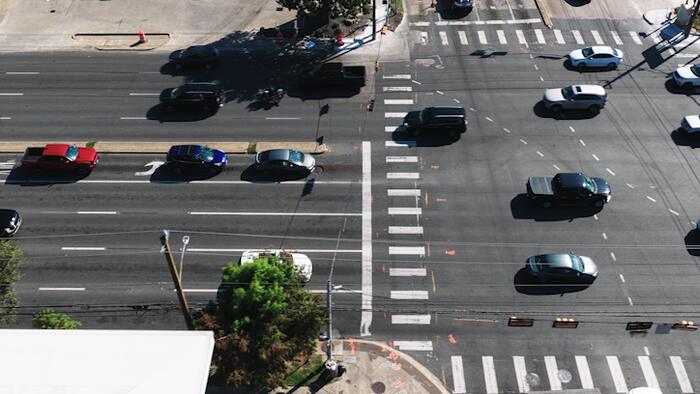
Ten pedestrians were killed along Westheimer Road in a single year.
According to federal and state crash data, the deadly 3.8-mile stretch between the West Loop and Fondren Road makes Westheimer one of the most dangerous pedestrian corridors in the United States.
That road changed everything for one family after a late-night phone call on Oct. 15, 2022.
A Houston police officer called Mike and Cathy Watford from the scene of a fatal pedestrian crash on Westheimer Road. The person killed was their 19-year-old granddaughter, Hailey Reed.
“You always think bad things when you get a phone call in the middle of night, but never in my wildest dreams that I think it would have been that phone call,” Mike Watford said.
Hailey Reed was one of 10 pedestrians killed that year along a single 3.8-mile stretch of Westheimer Road between the West Loop and Fondren Road.
Westheimer was among the deadliest roads in the United States for pedestrians in 2022, according to National Highway Traffic Safety Administration (NHTSA) and Texas Department of Transportation (TxDOT) data cited in a KPRC investigation.
Four years later, Hailey’s family is still asking what can be done to prevent another death. And ENOUGH found some safety improvements aren’t expected to be finished until 2028.

Reed was a nursing student, her family said. She worked at the House of Pies on Westheimer to pay for tuition.
She was killed less than two blocks from her workplace.
What happened the night Hailey Reed was killed on Westheimer?
A police report reviewed by ENOUGH said Reed was struck around 2:30 a.m.
The report said Reed crossed against the light, reached the median and was outside the crosswalk when she was hit by an F-150.
“I was driving when I just heard a loud noise,” the driver told police, according to the report. The driver said she never saw Reed.

She was never ticketed and never charged with a crime.
While Cathy is deeply disappointed that the driver was never held accountable, she acknowledged that Hailey appeared to be crossing outside the crosswalk.
But for Hailey’s grandparents, the question isn’t just what happened that night. It’s what could change to make Westheimer safer for the next person crossing the road.
Both Mike and Cathy Watford said they want changes that would make it easier for drivers to see pedestrians on Westheimer and other major Houston roads.
“Better lighting,” she said.
Mike Watford said crosswalk lighting could help drivers spot someone in the area.
“Especially at a crosswalk you think they would have some type of lighting to where you know a driver can see it — see someone standing there — instead of trying to pick them out of all the background lights, you know that blinds you,” he said.
Westheimer safety improvements are coming. Why will they take until 2028?
The Watfords want safer crossings. But four years after Hailey’s death, ENOUGH found no substantial safety improvements along Westheimer.
Now, TxDOT says changes are coming. The catch? They’re not expected to be completed until summer 2028.
In a note to ENOUGH, TxDOT said it plans next year to award a contract to build what it calls “enhanced crosswalks” at 23 intersections on Westheimer between Loop 610 and Highway 6.
An example of the updated design can be seen at a reworked intersection near Memorial Park, at Westcott & Blossom streets. The intersection includes brighter signs, a wide median, and new road paint intended to slow drivers.
In a statement TxDOT said the following:
“TXDOT is enhancing pedestrian safety along Westheimer Road with the installation of enhanced crosswalks at 23 intersections between Loop 610 and SH 6.
The enhanced crosswalks feature highly visible pavement markings designed to draw drivers’ attention to pedestrian crossings and encourage safer driving behavior. The improvements are intended to shorten crossing distances, reduce vehicle speeds and significantly increase driver compliance at crosswalks.
The pavement markings will make pedestrian crossings more visible and help create a traffic-calming effect by visually narrowing travel lanes, encouraging motorists to slow down and pay closer attention to pedestrians along the corridor.
Westheimer Road is a major corridor that serves businesses, neighborhoods and destinations across west Houston. These enhancements reflect TxDOT’s commitment to making the roadway safer for everyone who uses it.
The project is scheduled to let in fall 2027, with construction expected to begin shortly thereafter. The public can expect the improvements to be completed by summer 2028."
See where pedestrian crashes happened in Harris County
Houston promised to eliminate traffic deaths by 2030. Is that goal still on track?
Katie Alexander, a licensed peace officer with the Oak Ridge North Police Department and a member of the State of Texas Pedestrian Safety Task Force, told ENOUGH the state has “significant problems” with pedestrian fatalities.
The concerns about Westheimer are part of a much larger problem.
More than 800 pedestrians were killed across Texas in 2022. And Houston has already committed to an ambitious goal: eliminating traffic deaths and serious injuries by 2030.
But with that deadline approaching, where does the city’s Vision Zero initiative stand?
In Houston, ENOUGH raised questions about the status of the city’s Vision Zero initiative, a program launched in 2019 under then-Mayor Sylvester Turner with a goal “to eliminate fatalities and serious injuries in Houston by 2030.”
Vision Zero is a national road-safety approach that can include redesigning streets, reducing lanes, lowering speed limits and prioritizing pedestrians and cyclists.
Alexander told KPRC, “We all want to hit zero,” but questioned feasibility on the current timeline.
Vision Zero projects can be controversial, including the redesign of 11th Street in the Houston Heights that reduced vehicle lanes and added dedicated, curbed bike lanes.
Houston Public Works crash data comparing 2019 and 2023 showed “measurable improvements” on 11th Street, including a 36% reduction in crashes.
We asked Houston’s mayor about Vision Zero. Here’s what his office said.
Mayor John Whitmire declined an on-camera interview request about Vision Zero for this story.
In a statement provided after ENOUGH asked about the future of Vision Zero in Houston, the mayor’s office did not mention Vision Zero, but referenced the importance of data-driven decisions and teamwork in roadway safety.
Whitmire’s office stated: “The City of Houston regularly analyzes data to improve roadway safety and make our streets safe for all users. This includes reviewing data about dangerous traffic intersections within Houston city limits. To support these efforts, the City works closely with Tax Increment Reinvestment Zones (TIRZs), Harris County, and the Texas Department of Transportation (TxDOT) to share information and coordinate initiatives that improve traffic safety across Houston’s roadways.”
The statement did not directly address whether Houston remains committed to the Vision Zero goal of eliminating traffic deaths and serious injuries by 2030.
Who is responsible for preventing pedestrian deaths?
Even as officials consider changes to road design, pedestrian behavior remains part of the safety conversation.
Alexander told ENOUGH that about 70% of fatal pedestrian crashes involve pedestrians not using crosswalks, crossing highways, crossing in the dark, or not waiting for the light to change.
“Approximately 70% is, it’s not the driver’s fault,” she said.
But for families like the Watfords, the question is how to prevent the next tragedy — regardless of who is at fault.
“There’s no closure,” Cathy Watford said. “It’s just hanging there.”
She said she hopes other families can avoid similar tragedy.
“I wouldn’t want another family to go through what we went through with Haley. No, never,” she said. “But just educate your family. On driving and crossing roads and be aware of your surroundings.”


